
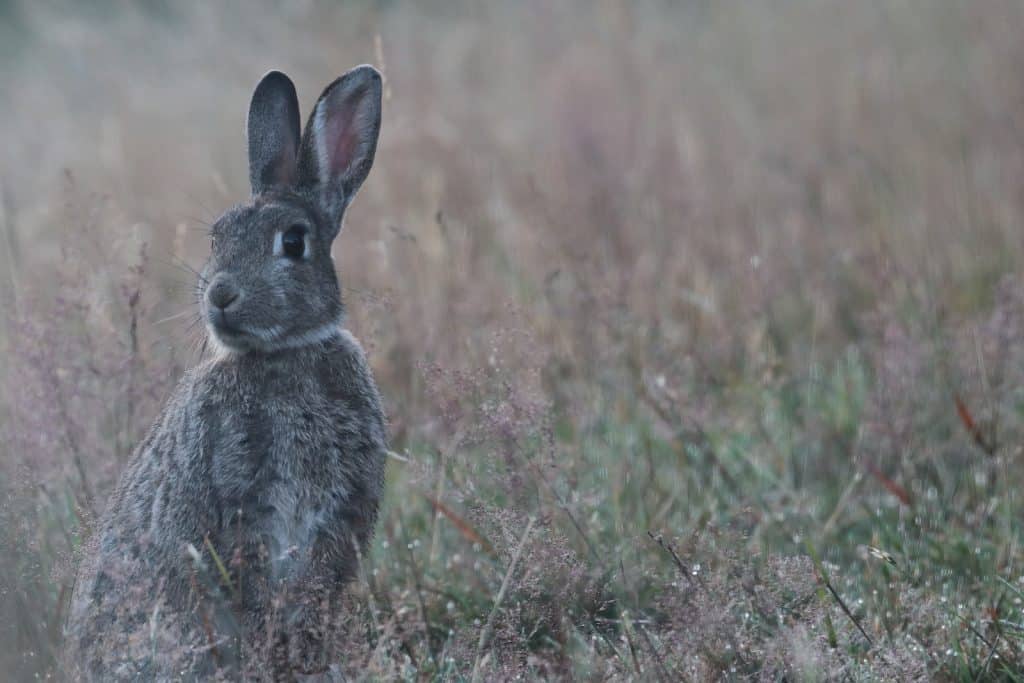
The volcano rabbit, which is only found in Mexico, is the second-smallest rabbit in the world after the pygmy. It is also the most primitive rabbit and hare species in all of the world.
According to estimates, there are just about 1,200 volcano bunnies left in the wild. They are among the rare small mammals on Earth. They are listed as an endangered species, which is not surprising. They are not suitable pets.
This is all you need to know about volcano rabbits.
Here are some quick facts about Volcano Rabbits
| Species Name: | Romerolagus diazi |
| Family: | Leporidae |
| Care Level | High-maintenance |
| Temperament: | Docile |
| Color Form: | Yellowish-gray |
| Lifespan: | 7 to 9 Years |
| Size: | 0.86-1.3 pounds |
| Diet: | Herbivorous |
Volcanic Rabbits Overview
The volcano rabbit is the second-smallest rabbit in the world, and it’s found just outside Mexico City. These rabbits are named after the four volcanic islands that lie just southeast of Mexico City.
The dark fur of the volcano rabbit is a result of its ability to blend in with volcanic soils and rocky terrain. The volcano rabbit is the last surviving species of their genus and diverged from the European rabbit 40 million years ago.
Volcano rabbits eat mainly zacaton bunchgrass, a tall grass that grows on alpine slopes and volcanos. They get nutrition from the dense, tall zacaton grass, which also provides cover against predators like red-tailed Hawks, long-tailed Weasels, and Bobcats.
The bark of alder trees, and spiny herbs are other sources of nutrition.
The threat to volcano rabbits is increasing, as habitat changes are the primary cause. Human encroachment is also a threat to their survival. Sadly, although it is illegal to hunt volcanic rabbits, these laws are seldom enforced.
It does appear that their population is increasing. This could be due to recent conservation efforts that include better farming practices and the preservation of sacaton grass.
What Does it Cost to Get Volcano Rabbits?
Due to their endangered status, these rabbits cannot be found in a pet shop or breeder. You might have the chance to find one in its natural habitat.
The Typical Behavior and Temperament
Volcano rabbits can be semi-social and live in groups of two to five individuals. The breeding pair is the dominant member of these groups. Only that pair can reproduce. The dominant male is the breeding pair’s female and often takes control of the group. The aggressive male at the top is less common.
Volcanoes are active mostly at dawn and dusk, just like other rabbits. Like other rabbits, their communication method is to thump their feet. This species, however, is unique because it is the only Leporidae member that can make vocal sounds. These sounds include a high-pitched bark sound and a lower-pitched, squeaking sound.
Appearance and Varieties
Volcano rabbits, which are the second-smallest of all rabbit species, weigh less than 1.3 pounds. The average length of a fully grown individual is 9 inches from their tip to their tail. Some have even been known to grow to as much as 12 inches. Male volcano rabbits are typically larger than females.
The miniature rabbit is small and round with short ears and legs. It also has a vestigial tail. Their thick, short fur has a yellowish-gray coloration.
Volcanoes are slower than other rabbits and therefore more vulnerable to predators. Habitat loss can have a huge impact on their numbers. Volcano rabbits can be easily captured by local predators if they don’t have a thick, dense zacatongrass to hide in.
How to Care for Volcano Rabbits
Volcano rabbits can be more difficult to care for than domestic rabbits because they are wild. Although they can be tamed, it takes time.
The care needs of a volcano are very similar to domestic dogs. It is important to ensure that your volcano has a healthy diet, an appropriate enclosure, companionship, medical care, and proper medical care.
Your volcano will be fine with a standard rabbit enclosure. They are easier to clean and have removable bottoms. So that the wire doesn’t cut into the feet of the rabbit, cover the bottom with soft bedding. Wood pellets and hay are good options for bedding. Avoid using paper bags, newspapers, towels, or paper towels as they can tear easily.
You might place a hay feeder in the enclosure so your bunny has something to eat whenever they feel hungry.
First, remove your pet from the enclosure and then place them in a secure and clean area. Do not use household cleaners such as bleach, detergents, or toilet cleaners as these can be toxic to volcano rabbits. Use only natural cleanings products such as lemon juice and water.
Volcano rabbits, like other rabbits, are great chewers. They will chew on almost anything, even wood. Their constant chewing helps them file their ever-growing incisors. You will need to bunny-proof any rooms your bunny can access.
You can also keep wooden fixtures out of reach by covering electrical wires with tough plastic. This will prevent them from chewing on the wires. You should also ensure that your rabbit-friendly chew toys are always available for them. This will keep them from chewing on wooden furniture and walls.
Are Volcano Rabbits compatible with other pets?
Volcano rabbits can be extremely fearful, and this is understandable as they are prey to nearly every carnivorous creature in their environment. Volcano rabbits cannot tolerate pets cats and dogs like domestic rabbits.
Volcano rabbits are very nervous about being exposed to carnivorous animals. This should be avoided at all costs.
How to feed your Volcano Rabbits
A volcano rabbit should eat hay, just like other rabbits. You can give your rabbit fruits and vegetables sparingly to add variety. You can cut them into small pieces to make it easier for your bunny to swallow. Supplements and pellets for rabbits are also great.
Your volcano must always have fresh water and hay. To ensure that your volcano doesn’t knock over its water, use a heavy and shallow bowl.
Keeping Your Volcano Rabbits Healthy
Volcano rabbits, despite their small stature, are extremely resilient. Because they evolved in a rugged environment, this is why they are so resilient. They are therefore not susceptible to many diseases.
It is an entirely different story in captivity. Because their immune systems are not equipped to fight common diseases in rabbits, they can become fatally ill. Make sure you get them vaccinated. Also, don’t keep your rabbit with other rabbits.
Regular visits to your vet are the best way to keep your rabbit healthy. It’s a good idea also to be familiar with the signs and symptoms of illness in volcano bunnies. This will help you act faster. You will be able to recognize signs such as a poor appetite, restlessness, unsteady gait, or sleep longer than usual.
Breeding
Volcano rabbits are able to mate for the rest of their lives. Only dominant males and females can mate, as previously mentioned. They will continue to do so until one of them is dead, at which point a lower-ranking member takes over.
Although volcanoes can breed throughout the year, it is spring when they are most active.
Captive volcano rabbits reach sexual maturity at five months old and eight months for females. After 40 days of gestation, the female gives birth and then gives birth to 1 to 4 litters weighing less than 3 ounces each. Female volcano rabbits can have up to five liters each year.
Are Volcano Rabbits Suitable For You?
Volcano rabbits can be found in the wild. They are not suitable pets. This, combined with the fact they are endangered, will make it clear that these rabbits should be cared for by professionals.
You can risk causing stress and new diseases to the rabbit if you do it yourself.
To maintain the social dynamics of volcanoes, you will need to adopt them as a couple, or as a group. You might not be able to provide proper care for a group of wild rabbits. Do not try to capture a wild volcano rabbit.
Summary
The adorable volcano rabbit isn’t the right choice if you are looking to have a pet rabbit. These animals are endangered and are now wild. The good news is that conservation efforts are working.
Is it true that volcanic rabbits are extinct?
The volcanic rabbit is critically endangered, with just around 7,000 animals left in the wild.
Is the oldest rabbit alive and well?
Coal (b. 2005) is the oldest living rabbit, at least 15 years and 243 days old.
In human years, how old is four rabbit years?
38 years Human Years to Rabbit Years Chart Human Age Rabbit Age 1 year*** 20 years 2 years, 26 years, 3 years, 32 years, and four years 38 years
In human years, how old is a 9-year-old rabbit?
Each rabbit year after the first is equal to six human years. So a rabbit is 75 years old when it reaches the age of ten.
What is the oldest dog in the world?
Gino, a rescue pup, is officially the world’s oldest living dog, and he lives in luxury in California. On November 15, Guinness World Records proclaimed him the oldest living dog. He is exactly 22 years and 52 days old.
What is the world’s rarest volcano?
Lengai, Ol Doinyo Ol Doinyo Lengai is the only volcano in the solar system known to still produce carbonatite lava, which has peculiar qualities. But Ol Doinyo Lengai is more than its singularity. The black lava it spews allows us to see into an otherwise inaccessible part of our planet.
Is there a dead volcano?
Mount Kilimanjaro in Tanzania, Africa, and Mount Fuji in Japan are examples of dormant volcanoes. Extinct Species Extinct volcanoes are ones that have never erupted in recorded history. Mount Thielsen in Oregon and Mount Slemish in Co. Antrim are two examples of extinct volcanoes.
What is the world’s largest volcano?
Because photons is so heavy, the Earth’s crust has sunk hundreds of meters. According to a recent study, two tiny, guano-covered islands visible above the waves in the central North Pacific Ocean are only the points of our planet’s greatest single volcano.
What is the temperature of blue lava?
10,830 °F Given its warmth, lava is red-orange in hue. Temperatures of at least 6,000 °C (10,830 °F) are required for really blue lava, which is significantly higher than any lava can naturally obtain on Earth’s surface.
What is the cause of the volcanic rabbit’s plight?
This species is endangered because to habitat degradation caused by cattle grazing and agriculture, as well as logging and human-induced forest fires.